

TRIPLING WEBSITE LEAD CONVERSIONS THROUGH DATA-DRIVEN OPTIMIZATION
Med-Tech Start Up | Healthcare Technology | Marketing Specialist
Overview
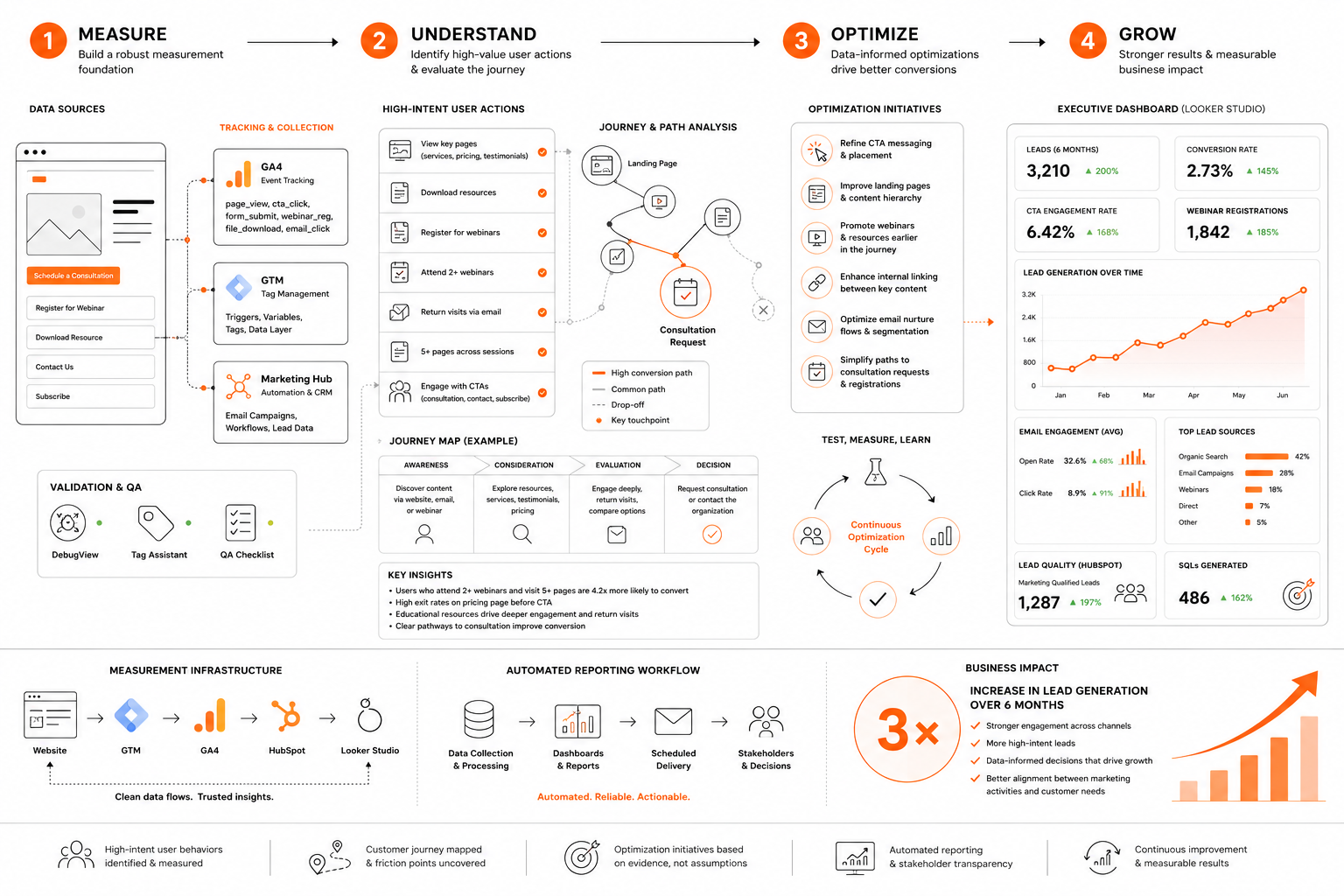
At this start up, I helped improve the effectiveness of our digital marketing efforts by strengthening website measurement capabilities and supporting initiatives designed to increase lead generation. By leveraging analytics, conversion insights, and marketing technology, we were able to significantly improve website performance and better understand how visitors engaged with key content and calls-to-action.
The Challenge
While this company had an established digital presence, there was an opportunity to generate more qualified leads through the website and gain greater visibility into which marketing activities were contributing to conversions. Without a comprehensive measurement framework, it was difficult to identify opportunities for optimization and accurately assess performance.
The Goal
Increase website lead conversions while building stronger attribution and reporting capabilities to support data-driven decision making.
Identified High-Value User Actions
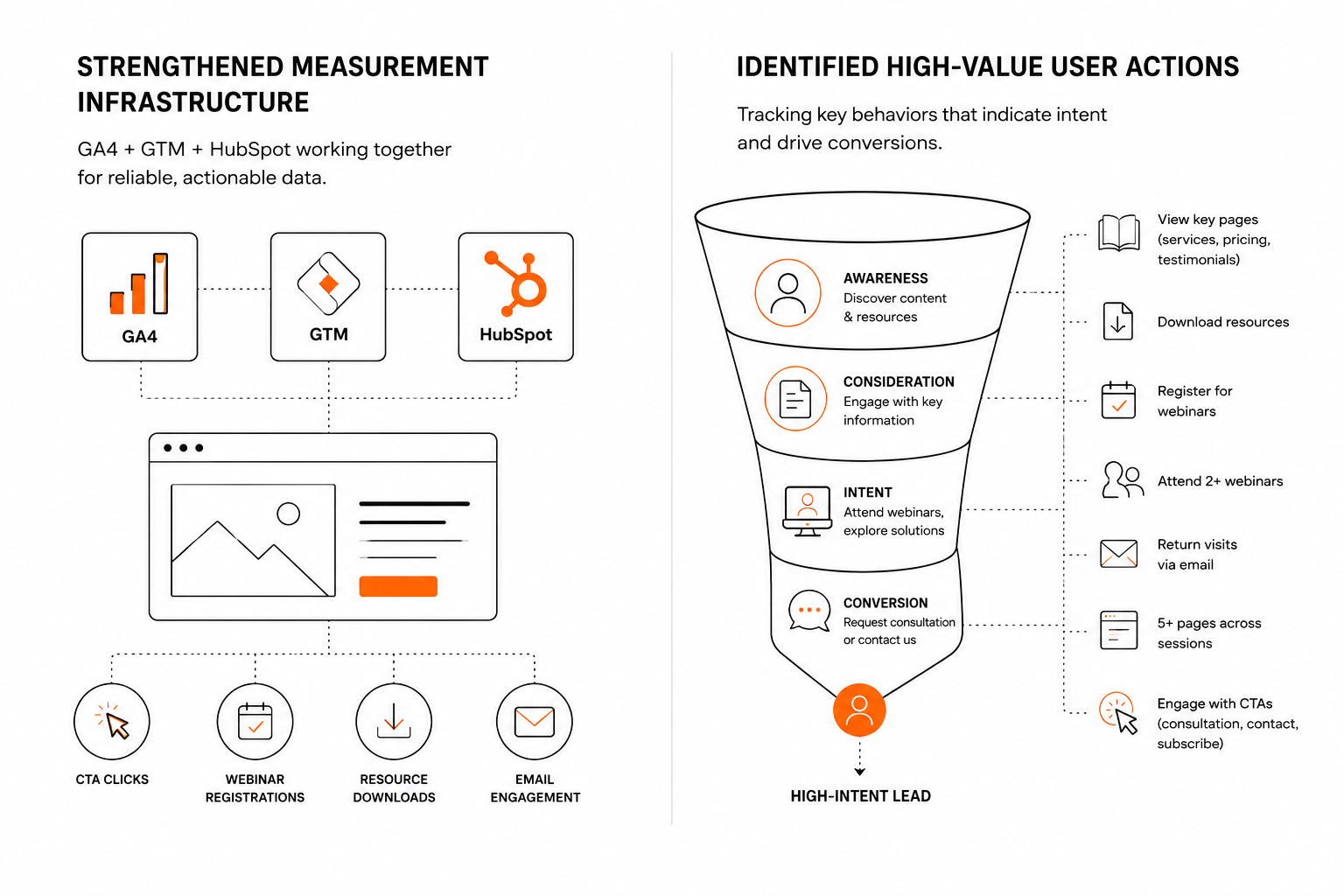
Configured custom event tracking to capture meaningful website behaviors that indicated purchase intent or progression through the marketing funnel. Rather than focusing solely on form submissions, I identified and measured the micro-conversions that often preceded lead creation and sales conversations.
Tracked engagement with high-value calls-to-action, including requests to schedule consultations, register for informational webinars, download educational resources, subscribe to email communications, and contact the organization for additional information. Monitored CTA click-through and completion rates to understand which offers and messaging resonated most effectively with prospective customers.
Expanded measurement beyond website interactions by incorporating behavioral indicators from marketing automation and email campaigns. Key engagement metrics included:
Opening and clicking links within multiple HubSpot email campaigns, signaling sustained interest and deeper engagement.
Returning to the website after email interactions to continue researching products, services, or resources, as measured through GA4.
Visiting five or more pages across one or multiple sessions, suggesting active evaluation and information gathering.
Engaging with high-intent content such as pricing information, service descriptions, FAQs, testimonials, and contact pages.
Registering for and attending informational webinars managed through Zoom Webinars, including participation in more than one webinar.
Repeatedly interacting with key conversion points, such as webinar registration forms, downloadable resources, and consultation request forms tracked through GTM and GA4.
Strengthened Measurement Infrastructure
mplemented Google Analytics 4 (GA4) and Google Tag Manager (GTM) to establish a more robust foundation for marketing measurement. Developed a scalable event tracking framework that improved visibility into website engagement and enabled more accurate reporting on key performance indicators, including CTA interactions, conversion rates, and lead generation trends.
Conducted a comprehensive audit of existing analytics configurations within GA4 and GTM to identify gaps in data collection, inconsistent naming conventions, and opportunities to improve reporting accuracy. Standardized event definitions and documentation to ensure that marketing activities could be measured consistently over time and across campaigns.
Designed and deployed tracking for critical website interactions using Google Tag Manager, enabling the team to move beyond basic pageview reporting available in Google Analytics 4 and gain deeper insight into how users engaged with content throughout the customer journey. This enhanced measurement approach provided a clearer understanding of which touchpoints contributed to lead generation and where users encountered friction before converting.
Established processes for ongoing validation and maintenance of tracking implementations using GA4 DebugView, Google Tag Assistant, and routine QA procedures to preserve data quality as the website evolved. By creating a more reliable measurement infrastructure, stakeholders gained greater confidence in performance reporting and were better equipped to make informed, data-driven marketing decisions.
My Approach:
Evaluated the Customer Journey
Analyzed user behavior patterns in Google Analytics 4, including Explorations, path analysis reports, and event data, to understand how visitors navigated the website and identify opportunities to reduce friction throughout the conversion process. Reviewed metrics such as page engagement, navigation paths, event completion rates, and drop-off points to uncover insights into user intent and barriers to conversion.
Through this analysis, I identified pages with high exit rates immediately preceding key conversion actions, navigation paths that led users away from high-value content, and instances where visitors repeatedly returned to informational pages without progressing to a lead-generating action. I also observed that users who engaged with educational resources, attended webinars, or visited multiple service-related pages were more likely to convert, highlighting opportunities to better connect these touchpoints throughout the website experience.
Synthesized these findings into customer journey maps created in Figma, visually documenting key touchpoints, user goals, pain points, and decision-making moments across the buyer journey. These journey maps helped align stakeholders around the customer experience and informed recommendations for improving website navigation, content placement, and conversion pathways.
Based on these insights, I recommended changes such as repositioning calls-to-action on high-traffic pages, improving internal linking between related content, surfacing educational resources earlier in the journey, and simplifying pathways to consultation requests and webinar registrations. These recommendations provided a shared framework for prioritizing website enhancements that supported both user needs and business objectives.
supported Conversion Optimization Efforts
Leveraged insights from Google Analytics 4, Google Tag Manager, and HubSpot reporting to guide website and campaign enhancements designed to improve conversion outcomes. Evaluated the impact of these efforts through changes in conversion rate, lead volume, CTA engagement, email performance, and overall website effectiveness, helping drive a threefold increase in lead generation over a six-month period.
Implemented and supported a variety of optimization initiatives informed by performance data, including refining CTA messaging and placement, updating landing page layouts, improving access to high-performing content, enhancing webinar promotion strategies, and adjusting email nurture workflows to better align with observed user behaviors. Recommendations were prioritized based on their potential impact and the strength of supporting data.
Monitored the performance of these changes over time using GA4, HubSpot, and dashboard reporting to determine whether they contributed to improvements in engagement and conversion metrics. In addition to the overall threefold increase in lead generation over six months, I tracked indicators such as increases in CTA interaction rates, stronger email engagement, higher webinar participation, and improved progression through key conversion pathways to evaluate the effectiveness of optimization efforts.
Collaborated with cross-functional stakeholders to prioritize opportunities based on measurable user behavior rather than assumptions. This data-informed approach supported continuous improvement efforts across both digital experiences and marketing campaigns while fostering greater alignment between marketing objectives and customer needs.
Developed Reporting Processes
Built reporting frameworks that provided stakeholders with greater transparency into marketing performance and lead generation trends using Google Analytics 4, HubSpot, and Looker Studio dashboards. Consolidated KPIs such as website leads, conversion rates, event activity, campaign performance, email engagement trends, webinar participation, and high-intent user behaviors into accessible reports that supported ongoing optimization and data-driven decision making.
Designed dashboards tailored to different stakeholder groups, ensuring that leadership teams had visibility into high-level performance trends while marketing teams could access more detailed operational metrics. Reporting views highlighted month-over-month changes, campaign contributions to lead generation, engagement trends across channels, and the behaviors most commonly associated with conversion.
Automated recurring reporting processes where possible to reduce manual effort and improve consistency, enabling stakeholders to monitor performance more efficiently and identify emerging trends that informed future marketing strategies. These reporting improvements reduced time spent compiling data, increased confidence in the accuracy of performance insights, and created a more proactive approach to identifying opportunities for optimization.
Changes Made
To support improved lead generation performance, I implemented and recommended several enhancements across this company’s marketing ecosystem. These efforts focused on strengthening measurement capabilities, reducing friction throughout the customer journey, and ensuring that high-intent visitors were presented with relevant opportunities to engage.
Key changes included:
• Implementing Google Analytics 4 (GA4) and Google Tag Manager (GTM) tracking to improve visibility into user behavior and campaign effectiveness.
• Developing a structured event tracking framework to monitor CTA interactions, webinar registrations, video engagement, and other high-value actions.
• Refining CTA placement and messaging on key pages to encourage deeper engagement and progression toward conversion.
• Identifying opportunities to improve internal linking and user pathways between educational resources, product information, and conversion-focused content.
• Supporting enhancements to email nurture workflows and webinar promotion strategies based on observed user behaviors and engagement patterns.
• Establishing reporting processes and dashboards that enabled stakeholders to monitor performance trends and make informed optimization decisions.
• Collaborating with marketing and sales stakeholders to align lead generation efforts with broader business objectives and improve visibility into the customer journey.
Results:
The initiatives implemented throughout this project contributed to measurable improvements in this company’s lead generation capabilities and marketing reporting infrastructure.
Key Outcomes
Tripled website lead conversions within six months, resulting in a 200% increase in website-generated leads.
Established a scalable measurement framework using GA4 and GTM that provided stakeholders with greater visibility into campaign performance and user behavior.
Improved understanding of the customer journey by identifying the website interactions and engagement patterns most closely associated with lead generation.
Enhanced reporting capabilities through standardized dashboards and recurring performance reviews, enabling more proactive optimization efforts.
Strengthened alignment between marketing and sales by improving transparency around lead generation activities and the behaviors that signaled purchase intent.
What I Learned
One of my biggest takeaways from this project was that optimization is an ongoing process rather than a one-time initiative. Implementing better tracking through GA4 and GTM helped uncover valuable insights, but the real impact came from using those insights to make informed decisions and continually refine our approach. This experience strengthened my belief that effective marketing requires both analytical rigor and a willingness to test, learn, and adapt based on evolving customer behaviors.
Tools Used
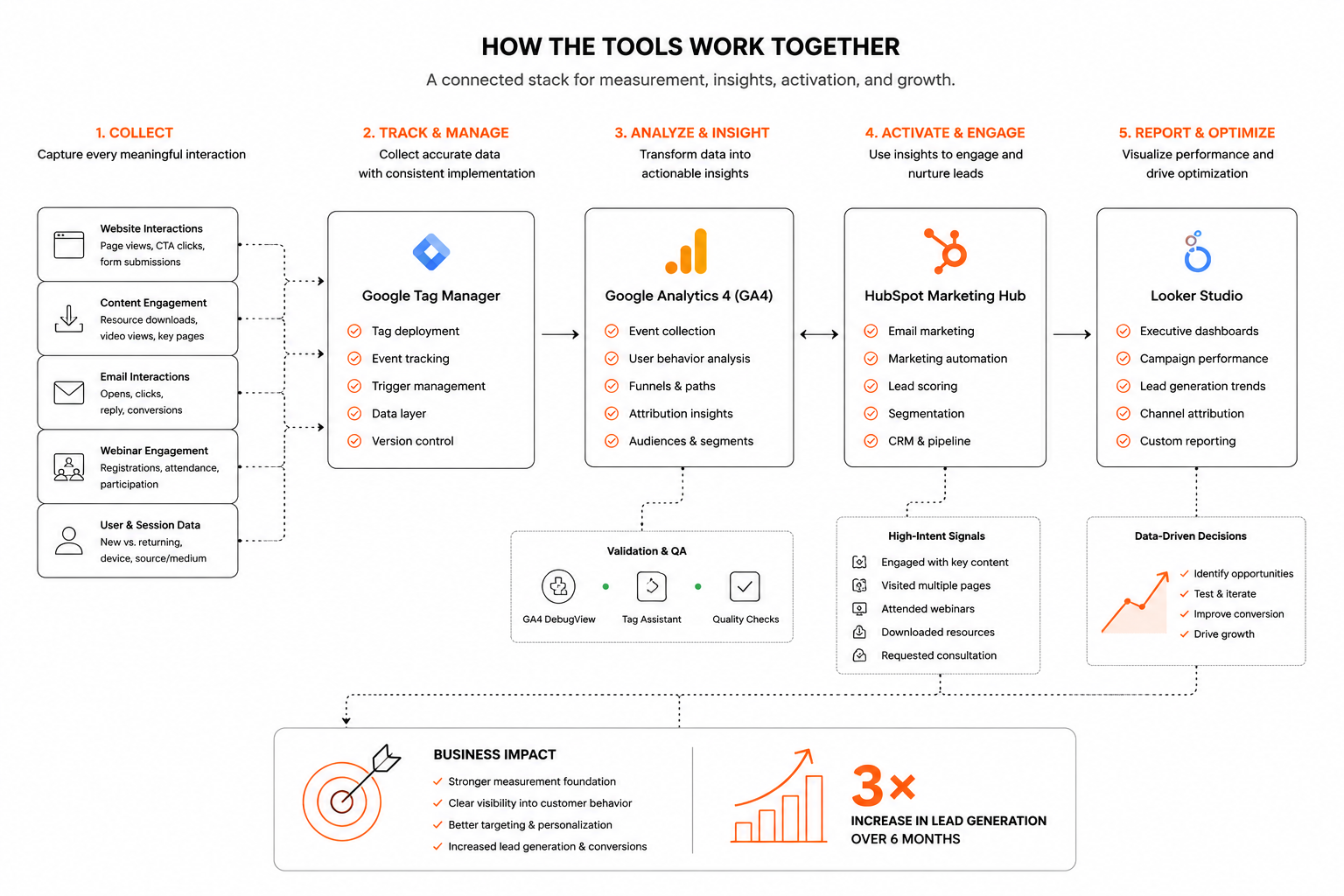
Google Analytics 4 (GA4)
Used to analyze user behavior, evaluate engagement trends, and measure the effectiveness of lead generation initiatives.
Google Tag Manager (GTM)
Implemented and managed event tracking to capture meaningful website interactions and improve attribution.
HubSpot Marketing Hub
Supported email performance analysis, marketing automation efforts, and lead management processes.
Looker Studio
Developed dashboards that translated complex datasets into accessible performance insights for stakeholders.
WordPress
Collaborated on website enhancements designed to improve user experience and support conversion objectives.
Microsoft Excel
Used for data analysis, trend identification, and organizing reporting outputs.